The companion to the book
Say it better, out loud and on the page.
Listen to the audio course, rehearse a real conversation, test yourself on real situations, and keep every framework card in your pocket.
Free from Paul M. O'Neill, English Language Lab. No account needed, and your notes stay on this device.
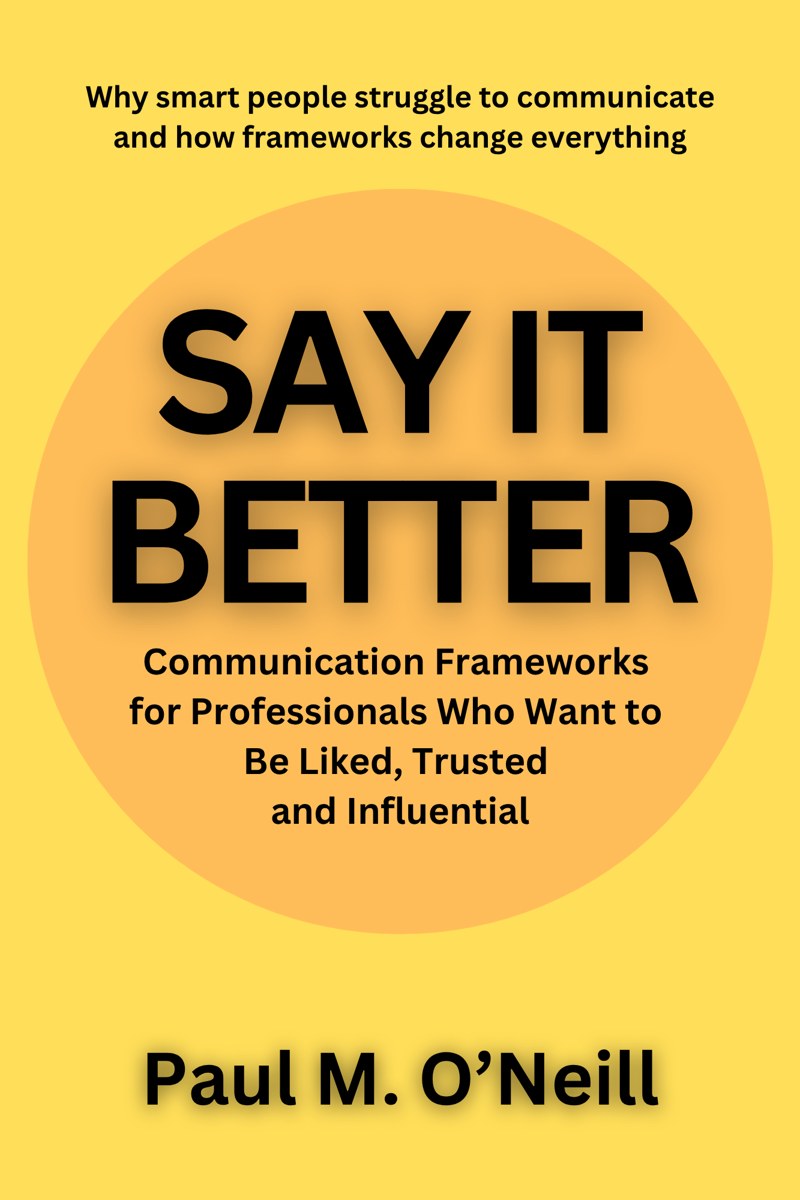
The problem is not your English. The problem is structure.
Liked, then trusted, then influential
Each step builds on the last. That's why the frameworks come in this order.
People like people who are like them.
People trust people they like.
People are influenced by people they trust.
Everything in the companion
Your Say It Better Scorecard
Fourteen work situations, five minutes, and a personal plan for which frameworks to learn first.
Difficult Conversations at Work
Five short audio episodes on feedback, saying no and complaints, with a workbook.
Six framework cards
FORD, PREP, ERA, SBI, DESC and LATTE. Save any card as an image to share.
Rehearse mode
Say each step out loud before the real conversation, and record yourself if you like.
Which framework fits?
Five real workplace situations. Choose the right framework for each one.
Read two free chapters
Why smart people struggle to communicate, your first framework, and a guide for when your mind goes blank.
Free self-assessment, about 5 minutes
Your Say It Better Scorecard
Fourteen real work situations. Answer each one honestly and find out which frameworks from the book will make the biggest difference for you, and in what order to learn them.
How it works
- Select the problems that sound like you.
- Think of a real week at work. For each situation, choose Strong, Needs attention or A real problem.
- Watch your staircase fill with colour. The framework behind each situation appears when you answer.
- Read your plan: one framework a month, starting where you need it most.
Which problems do you recognise?
These are the five problems from Chapter 1. Choose as many as you like, or none.
Fourteen situations
If a question is difficult, read the simple version under it. There are no wrong answers, and nobody sees this unless you share it.
Your Say It Better plan
Answer all fourteen situations to see your plan.
Write about one real moment: where you were, who was there, what you wanted to say. A few sentences is enough. Next time, you'll know which framework to reach for.
Send your results to your coach, or keep them in the back of your copy of the book.
Talk through your plan with Paul
You have your Scorecard results. Now let’s turn them into a plan. In a short call, we’ll look at the situations that came out as “Needs attention” or “A real problem”, choose the first framework to learn, and decide what to practise this week.
Pick a time that suits you.
Book a discovery session with PaulAudio course, about 19 minutes
Difficult Conversations at Work
Nobody ever taught you a structure for feedback, saying no, or handling a complaint. These five short episodes give you three. Press play, then open the workbook below.
The companion workbook
Keep it open while you listen, or come back afterwards. The exercises only work if you use a real situation, not a hypothetical one.
Quick reference
Your framework cards
Six frameworks from the book and its companions. Rehearse any of them, or save a card as an image for your phone, LinkedIn or WhatsApp.
Before your next conversation
The quick reference from Chapter 17. What do you need to do?
In this companion. The rest are in the full book.
Practise
Practice and notes
A framework only becomes a habit once you've used it more than once. Everything here is saved on this device only, in this browser.
This week's practice
Pick one framework and use it for real, on a conversation you've actually been avoiding. Not a hypothetical one. A real one. Then come back and write down what happened.
Practice log
Rehearsals you rate are added here automatically.
| Date | Framework used | Situation | How it went | Remove |
|---|
My notes
A line that landed, a mistake you recognised in yourself, a conversation you want to revisit.
Free to read
From the book and its guides
A companion guide to Say It Better
When Your Mind Goes Blank
Three communication frameworks that free your brain to speak, even when the pressure is on.
There is a moment of pure panic that every language learner knows, but nobody warns you about.
You've been studying for months. Maybe years. You've memorised hundreds of words. You've drilled your verb conjugations until you can recite them in your sleep. You feel ready.
And then you step into a café. A native speaker smiles and asks, “So, what do you think of the city so far?”
And then… nothing.
Your mind goes completely blank. You stutter. You mumble a quick “It is good, thank you,” and walk away feeling defeated.
You keep studying. You keep doing flashcards. You keep showing up. But in live conversations, the needle doesn't move. Your vocabulary feels trapped in your head.
You start wondering if you just aren't studying hard enough. If your memory is broken. If this is your ceiling.
It's not.
What you're experiencing has a name. Psychologists call it cognitive overload. And it is the most misunderstood bottleneck in second language acquisition.
The cruellest trick your brain plays on you
It feels like you've forgotten everything you know, when in reality, your brain is just trying to do too many things at exactly the same time. In the fraction of a second after someone asks you a question, your working memory has to:
- Translate the input you just heard.
- Search your mental dictionary for the right vocabulary.
- Conjugate the verbs correctly.
- Monitor your accent and pronunciation.
- And invent an interesting, engaging answer.
It's simply too much. Just like a computer with fifty browser tabs open, your brain eventually crashes. It freezes. So your brain does something perfectly rational but utterly counterproductive: it defaults to the shortest, safest answer possible. “Yes.” “No.” “Good.” This is the trap.
The secret to conversational fluency isn't cramming more vocabulary into your head. It's changing how you retrieve it.
The strategy that sounds too simple to work
I want to tell you about a concept that changed everything for me and my students. We call them communication frameworks.
Think of a framework as mental scaffolding. When you know the structure of what you want to say in advance, you remove the burden of deciding what to say next. By removing the “what,” you free up massive amounts of working memory to focus entirely on the “how” (the vocabulary, the grammar, the pronunciation).
You don't need to be naturally witty to sound fluent. You just need a roadmap. Here are three of the most powerful frameworks you can start using today to bypass the cognitive bottleneck.
But here's what nobody talks about
Fluency isn't just about knowing thousands of words. It's about giving your brain a reliable system to deploy the words you already know.
When you first use PREP, FORD or ERA, it might feel mechanical. That's normal. Think of them like stabilisers on a bicycle. Eventually, the frameworks fade into the background, becoming an invisible skeleton underneath your own natural personality.
And if the voice in your head says this is too easy, this doesn't count as real speaking, that voice is wrong.
The most structured, framework-driven conversation you have this week might be the most productive thing you've done for your language learning in months.
Try it this week
- PREP: Pick a question you'll probably be asked this week and answer it in four sentences, out loud.
- FORD: In your next coffee break or meeting warm-up, choose one letter, ask the question, then listen.
- ERA: Tell someone about your weekend in three steps. Past tense, then feelings, then now.
The full book
What's inside Say It Better
Communication frameworks organised from being liked, to being trusted, to being influential. Each one is simple enough to learn in ten minutes and powerful enough to use for the rest of your career.
Enjoyed the companion?
You've met FORD, PREP, SBI, DESC and LATTE here. The full book has nine more, from STAR for job interviews to SPIN for selling ideas, plus a guide to choosing the right one in the moment.
About Paul
Paul M. O'Neill has spent over 25 years teaching English to professionals from every continent and every industry: engineers, lawyers, project managers, CEOs.
What they all have in common: they're brilliant at what they do, but somewhere along the way, communicating in English became a barrier instead of a bridge. He stopped teaching perfect grammar and started teaching structure. He believes confidence matters more than correctness, and structure beats vocabulary every time.
Keep in touch
Find more resources at englishlanglab.co.uk, or connect with Paul on LinkedIn. Tell him which framework you tried first.